

































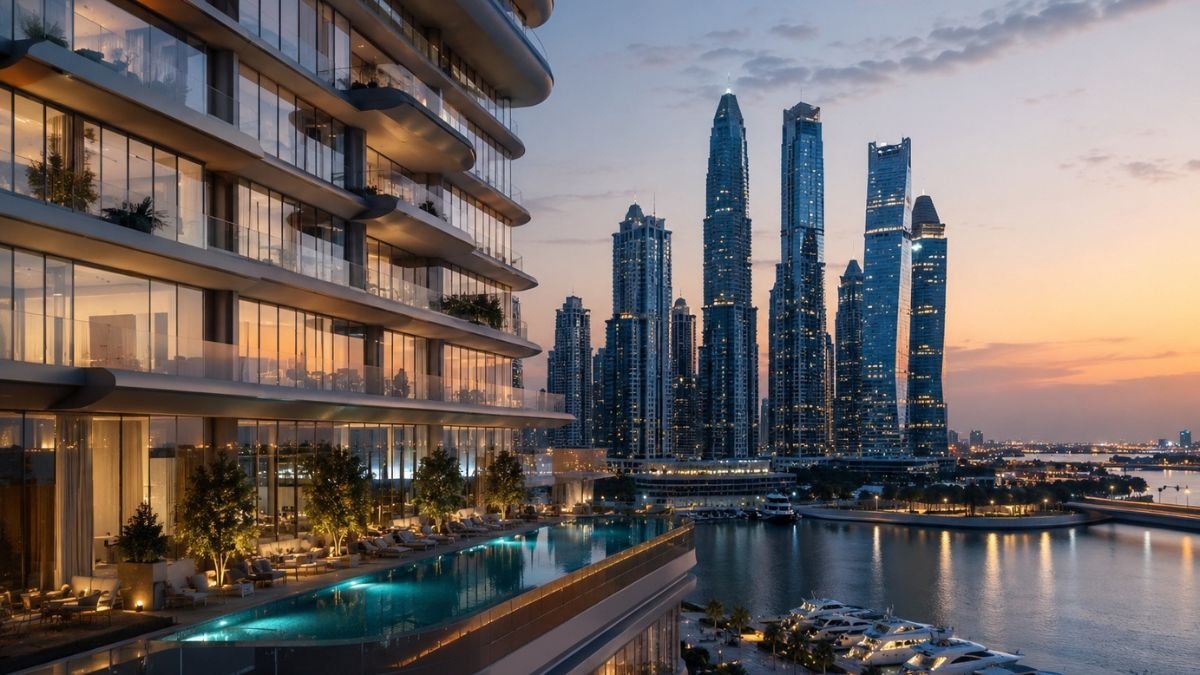
Dubai, UAE —- A name on the building now costs Dubai buyers roughly a third more than the unit next door. The question for capital, as supply of hospitality-linked homes accelerates, is whether that gap is a return or a receipt.
Dubai already holds the largest stock of branded homes anywhere. Savills counts close to 140 active projects in the city, the highest concentration globally, and consultancy VVS Estate expects that number to climb about 80% to nearly 250 projects by 2030. The premium attached to those homes has so far proven sticky. Whether it stays that way as inventory expands is the open trade.
What The Numbers Show
Hospitality-branded units in the UAE trade at a 30% to 40% markup over comparable unbranded stock, according to Zeeshan Shah, founder of advisory firm Elevate, with the gap widening in the most sought-after districts. That is the visible cost of the Dubai branded residences premium.
The return side is less uniform. Branded homes in prime areas yield roughly 4% to 6% gross, per CBRE data, while mid-market unbranded apartments in high-demand communities can reach 7% or higher. On a pure rent-to-price basis, the branded buyer accepts a lower running yield in exchange for service, resale liquidity and a managed asset.
Supply is the variable shifting underneath those figures. VVS Estate projects close to 250 branded and hybrid projects by 2030 and as many as 400 by 2035, drawing on Property Finder’s pipeline of more than 2,300 off-plan developments across the UAE.
What The Premium Actually Buys
The case for paying up rests on durability rather than headline yield. “The more important question isn’t the entry price, it’s the total return,” Shah said, pointing to capital appreciation, the liquidity advantage of a globally recognised brand, and ownership benefits that travel across an operator’s hotel network.
That logic holds only where execution does. Abhishek Jalan, CEO of Grovy Developers, is blunt on the limit. “A well established brand alone will not guarantee you greater ROI than a non-branded product,” he said. The fundamentals that govern any Dubai asset, location, developer track record, service charges and district-level demand, still decide the outcome.
For the buyer, that reframes the Dubai branded residences premium as a bet on the operator holding service standards over a 10-year horizon, not on the logo itself.
Where This Sits In The Cycle
The expansion lands at a specific point in Dubai’s residential arc. Off-plan transactions dominated mid-June activity, and capital relocating into the emirate has tilted toward second homes and managed assets rather than speculative flips. Branded stock is the product built for that buyer: long-stay demand for serviced apartments has risen sharply, giving owners a tourism-linked income channel that unbranded units cannot easily replicate.
That demand profile is why the premium has held even as the broader market normalised. Affluent relocation buyers value predictability of management, and a hospitality operator sells exactly that.
The Constraint Worth Pricing
The risk is concentration meeting supply. A near-doubling of branded projects by 2030 introduces dispersion. Weaker entrants, second-tier operators or projects where service charges erode net yield will not command the full markup, and the average premium could compress even as trophy assets hold theirs.
Service charges are the quiet variable. A high recurring cost can convert a 5% gross yield into a thin net return, and branded buildings carry heavier operating budgets by design. Buyers paying the Dubai branded residences premium without modelling those charges, the operator’s tenure and the surrounding supply pipeline are buying a brand, not a return.
Reading The Next Phase
Watch whether the premium splits. The likely path is a widening gap between top-tier projects, where brand longevity and irreplaceable locations defend pricing, and mid-pipeline stock that competes closer to unbranded levels. The arrival of confirmed 2026 handovers such as Address Residences The Bay and St. Regis Residences Downtown will give the first clean read on resale and rental performance once units trade hands rather than launch.
For end-users planning to live in the home, the premium buys a managed lifestyle and lower maintenance risk, a reasonable trade if the operator is credible. For investors, the calculation is sharper: the branded route favours capital preservation and resale liquidity over running yield, so it suits buyers prioritising a durable store of value over cash flow. For Indian and NRI buyers, the appeal is concrete. A rupee that has weakened against the dirham raises the entry cost, but a brand-managed, rentable asset reduces the oversight burden of owning from abroad and offers a cleaner exit. The discipline is the same for all three: pay the Dubai branded residences premium only where the operator, location and service economics justify it, and treat the name as a starting point for diligence, not a substitute for it.
Discover more from Invest Dubai Today - Dubai Realty Insights
Subscribe to get the latest posts sent to your email.