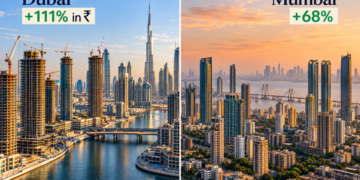


























Dubai, UAE — Indian nationals accounted for an estimated 20.6 per cent of property purchasing activity in Dubai during the first half of 2026, the largest share of any foreign buyer group, according to Harbor Real Estate analysis of DXBinteract data. The lead is not close: British buyers ranked second at 13.3 per cent, with Egyptians third at 12.6 per cent.
For a market that transacted heavily through H1 despite an active regional conflict, the nationality table is one of the more useful reads on where demand actually comes from. It suggests Dubai’s buyer base is broad, retail-heavy and anchored in the subcontinent rather than dependent on any single wealth corridor, with Indian investors in Dubai real estate setting the pace at the volume end of the market.
What the H1 2026 Buyer Data Shows
Behind the top three, Americans held 9 per cent of purchasing activity, Pakistanis 6.9 per cent, and Saudi and Australian buyers 5.7 per cent each. Germans (4.2 per cent), French (3.8 per cent) and Canadians (3 per cent) rounded out the top ten, per the Harbor Real Estate report cited by Khaleej Times.
The geography of that money is just as telling. Dubai Islands led apartment sales with AED 8.4 billion in H1 transactions, ahead of Airport City at AED 7.2 billion and Business Bay at AED 6 billion. In villas, Al Yalayis 1 topped the list at AED 10.6 billion. Land sales were led by Me’aisem Second at AED 10.1 billion.
Unit mix points the same direction. One-bedroom apartments took 34.9 per cent of all sales at 27,590 transactions, studios 23.4 per cent, and two-bedroom units 20.7 per cent. Nearly eight in ten deals, in other words, involved compact stock priced for yield rather than trophy hunting.
Why Do Indian Investors in Dubai Real Estate Keep Buying?
The structural draws have not changed: zero tax on rental income, 100 per cent foreign ownership in freehold areas (designated zones where non-residents can hold full title to property), and residency routes tied to ownership. What the H1 data adds is evidence that Indian capital is positioned at the liquid end of the market, where studios and one-beds dominate and resale depth is greatest.
That matters for entry logic. A buyer competing in the AED 1 million to 2 million bracket is buying into the deepest transaction pool in the emirate, which cuts exit risk even if price growth moderates. The concentration of Indian, Pakistani and Egyptian demand in this bracket also means the segment’s performance now tracks subcontinental and regional capital flows more closely than European ones.
A Market Shifting Down From Sprint Pace
Harbor Real Estate frames H1 2026 as the period when Dubai moved from record-setting growth into a slower but more durable cycle. Dr Mohanad Alwadiya, the agency’s CEO, put it plainly: “The strongest markets are not those that grow the fastest, but those that successfully transition from rapid growth to sustainable growth.”
The report attributes current demand to population growth, corporate relocation and wealth inflows rather than speculation, and notes that price growth has begun to moderate as new supply approaches. Alwadiya argues that rising inventory, when matched by real demand, “becomes one of the strongest foundations for a healthier and more sustainable market.”
The Supply Question Hanging Over 2026
The constraint is visible in the pipeline. More than 160,000 residential units are scheduled for delivery in 2026, against roughly 39,700 actually completed in 2025 and 30,500 in 2024. Harbor expects actual completions to come in significantly below schedule, and around 85 per cent of the future pipeline is apartments, precisely the stock that Indian and other retail investors favour.
If even half the scheduled units land, the compact-apartment segment absorbs most of the pressure. The report’s view is that this eases price growth rather than triggering a sharp correction, but that is a projection, not a guarantee, and it assumes population and business inflows hold through a period of regional volatility.
Three Numbers Worth Tracking Into 2027
The delivery count matters more than the launch count: watch how far actual 2026 completions run below the 160,000 scheduled. Watch whether Indian investors in Dubai real estate hold a share above 20 per cent in the full-year nationality data, since a slip would suggest currency or sentiment pressure biting. And watch one-bed pricing in Dubai Islands and Business Bay, the districts where new supply and retail investor demand will collide first.
What This Means for NRI Money
For NRI buyers, the H1 table is confirmation of scale, not a buy recommendation. Indian capital already sets the marginal price in the compact-apartment segment, which means NRI investors are competing mostly with each other, and yield discipline matters more than momentum. A weaker rupee raises the cost of entry but also raises the value of dirham rental income remitted home, so the currency argument cuts both ways. The sensible read of H1 2026 is that Dubai remains the default overseas property market for Indian money, at the exact moment the market is asking buyers to be more selective than at any point in the current cycle.
Discover more from Invest Dubai Today - Dubai Realty Insights
Subscribe to get the latest posts sent to your email.