



































Dubai, UAE — For three years, Dubai landlords set the number and tenants paid it. That balance is turning. As new supply lands and asking rents soften across several prime communities, the question for property owners is no longer how much rent will rise, but whether Dubai rental yields can hold once leasing income stops climbing.
The shift matters because rent is the part of the return investors can actually bank. Capital appreciation is a paper figure until a sale. When rents flatten while purchase prices stay elevated, the income side of the equation does the work, and that is where the current cycle is being tested.
What the Numbers Show
The clearest signal came in spring. The ValuStrat Price Index fell to 229.2 points in March 2026, a 5.9 per cent monthly drop and the first monthly decline since the post-pandemic recovery began, though values stayed 8.9 per cent above a year earlier. Apartments slid 6.3 per cent for the month and villas 5.8 per cent, according to the consultancy’s data reported by Gulf Business.
The pullback reached established addresses. Jumeirah Village Circle apartments fell 10.3 per cent, Burj Khalifa units 10.2 per cent and Jumeirah Beach Residence 9.9 per cent over the same month.
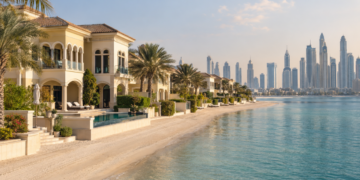
Rents have started to follow. Property Finder data showed average UAE rents down 5.4 per cent between the January-February period and April 2026, with Dubai off 6.7 per cent. In sought-after districts including Downtown Dubai, Palm Jumeirah and Jumeirah Lake Towers, asking rents had already eased by around 15 per cent.
Supply is the reason most analysts give. “By the end of 2026, we believe rental growth will stop compared to 2025, and that’s mainly due to the amount of supply that is coming in, as there are many projects that are expected to come online this year,” said Haider Tuaima, managing director and head of real estate research at ValuStrat.
Why This Resets the Yield Math
A cooling rental market does not automatically lower Dubai rental yields. Yields move on the gap between rent and price. In March, capital values fell faster than rents, which briefly supported the income ratio. The risk now is the reverse, where rents keep easing while sellers hold asking prices, squeezing the return new buyers can expect.
That is the calculation facing anyone entering at today’s prices. Cherif Sleiman, chief revenue officer at Property Finder, framed the broader move as orderly rather than a slide. “What this reflects is a natural rebalancing within a market that continues to operate from a position of grit and buoyancy,” he said.
For income-focused buyers, the practical takeaway is that Dubai rental yields are now driven by selection, not the market average. Newer stock in oversupplied pockets faces the most pressure on rent, while well-located and well-managed units retain tenants and pricing.
A Regional Split on Rents
Abu Dhabi has taken a different route. On 2 June 2026, the Abu Dhabi Real Estate Centre froze rental increases across residential, commercial and industrial contracts, with renewals and re-lets held at the previous value. The capital’s apartment rents had run about 15 per cent higher year on year, so the freeze caps a hotter market by regulation.
Dubai is letting supply do that work instead. The contrast shapes where mobile capital lands. Ali Ishaq, head of Abu Dhabi Residential at Savills, said a freeze “may also support investor confidence by encouraging higher tenant retention and reducing the likelihood of tenants downsizing purely to manage rental increases.” Dubai owners get retention from softer pricing rather than a rule, which keeps Dubai rental yields exposed to genuine demand.
Where the Reset Could Stall
Softer rents do not signal weak demand. Mortgage activity stayed firm, with roughly 10,800 residential mortgage transactions in the first quarter, up about 16 per cent year on year, helped by a three-month EIBOR near 3.69 per cent at the end of May. Buyers are still financing entries.
Capital is also still arriving, just selectively. Of the AED 40.63 billion in May transactions, off-plan and land each took about 40 per cent, while ready homes made up under 20 per cent. Population growth could absorb incoming units faster than expected, which would arrest the rent decline and steady Dubai rental yields before the squeeze deepens.
What to Watch Next
The spread between renewal rents and new-let rents is the indicator to track, since landlords typically defend renewals first and discount new tenants. Watch whether prime-district rents stabilise after their roughly 15 per cent adjustment, and how much of the 2026 and 2027 delivery pipeline actually completes on schedule.
Reading the Shift as an Investor
For investors, the message is that entry price and location now decide the return, not the rising tide. End-users hold more negotiating room than they have had in years to push down renewals and upgrade. For Indian and NRI buyers, a softer dirham-denominated rent paired with steadier capital values changes the timing question: a lower yield bought at a lower price can still beat a high yield bought at the top. The cycle has not broken. It has handed the pricing pen back to tenants, and Dubai rental yields will reflect who reads the handover first.
Discover more from Invest Dubai Today - Dubai Realty Insights
Subscribe to get the latest posts sent to your email.