

































Dubai, UAE — A market can post record numbers and quietly grow more fragile at the same time. Dubai’s apartment sector is doing both. Fresh transaction data for the first half of June shows buying activity holding up, but funnelling through a narrowing set of projects, areas and one dominant developer.
What The June Data Shows
Dubai registered 5,263 freehold apartment transactions worth AED 8.10 billion between June 1 and 15, according to a mid-month brief published by AIQYA Research on June 16, drawing on Dubai Land Department records.
Off-plan inventory accounted for 84.1% of those deals, up from 80.2% in May. Studios and one-bedroom units made up 76.3% of activity, with a median ticket of AED 1.09 million.
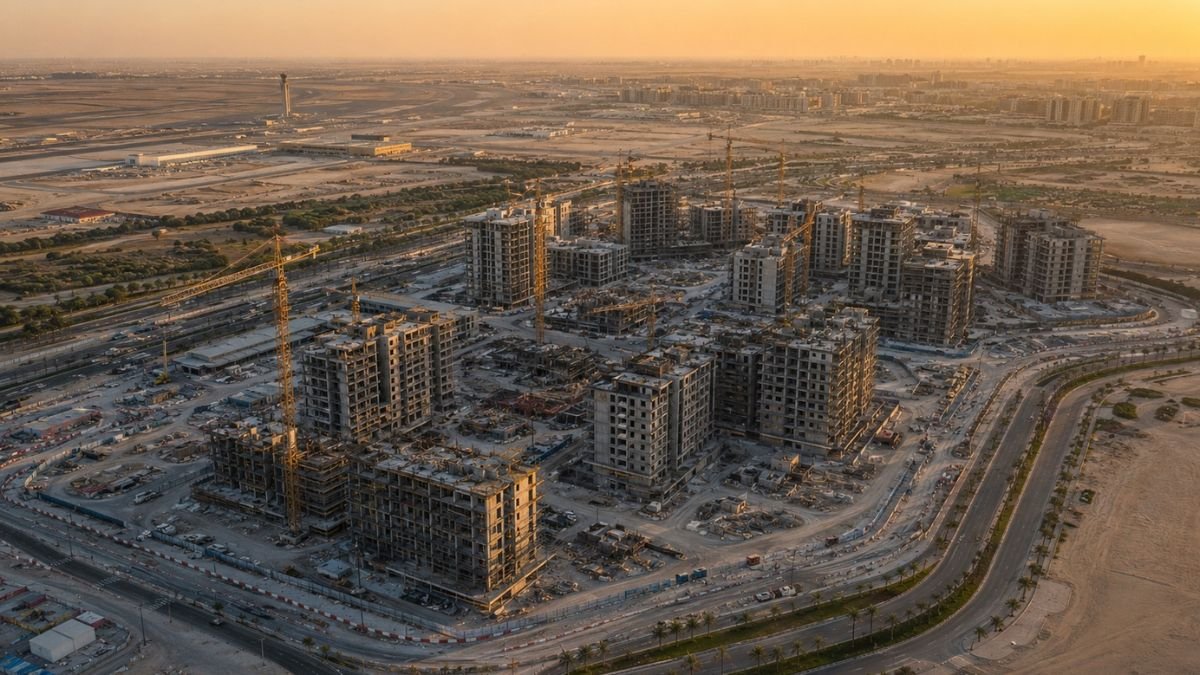
The breadth numbers are where Dubai property market concentration becomes visible. The five most active areas absorbed 45.5% of all apartment transactions. The single area of Madinat Al Mataar, in the Dubai South corridor, took 28.6% on its own.
At the project level, AZIZI VENICE 14 alone recorded 678 deals, roughly 12.9% of apartment transactions in the period. Across naming patterns, Azizi-branded launches accounted for about a third of identified activity.
Why The Breadth Matters
Volume measures demand. Breadth measures durability. The June data shows the two diverging.
When close to one in three apartment sales traces to a single developer, and one in eight to a single tower, the market’s momentum becomes tied to a handful of launch calendars. That is the core of rising Dubai property market concentration, and it changes the risk an end-buyer or investor actually carries.
The exposure is twofold. First is delivery risk: a buyer’s capital sits with one developer’s construction timeline and balance sheet rather than spread across the market. Second is resale depth. Liquidity that looks deep at the city level can thin quickly inside a specific project once dozens of similar units compete for the same secondary buyer at handover.
ValuStrat’s head of research Haider Tuaima has framed the wider backdrop carefully. “Dubai’s underlying demand drivers remain intact into 2026, but performance is likely to become more segmented,” he said in the firm’s 2026 outlook. Segmentation and Dubai property market concentration are two readings of the same shift: the gains are real but unevenly distributed.
Where This Fits in Dubai’s Cycle
This is not a market turning over. Knight Frank’s Faisal Durrani points to record sales volumes, resilient rents and population growth still underpinning values, with prime prices expected to rise around 3% and the mainstream segment about 1% through 2026.
fäm Properties chief executive Firas Al Msaddi has been similarly steady, noting “the market continues to show clear resilience even against a backdrop of regional uncertainty.”
Both readings can hold. Dubai property market concentration is a maturation feature, not a crash signal. As developers scale launches in master-planned districts such as Dubai South, transaction volume naturally clusters where the new supply sits. The question for a capital allocator is whether that clustering is being priced.
The Risk Investors Should Price
The constraint is straightforward. A buyer entering a top-selling off-plan project in a top-selling area is paying current launch pricing into the most crowded part of the market.
At handover, that same concentration that made the project easy to buy can make it harder to exit at a premium, because the wave of comparable resale stock arrives together. Compact studios and one-bedroom units, which the June data confirms as the liquidity engine, are the most exposed to this dynamic given how interchangeable they are.
None of this argues against Dubai. It argues for looking past the project everyone is buying.
What To Watch Next
Three signals will show whether Dubai property market concentration is tightening or easing. Watch whether the top-five-area share climbs above its current 45.5% in the second half of June. Watch the single-developer share, currently near a third, for any broadening as rival launches compete. And watch the off-plan ratio: a move back toward the ready market would signal demand spreading rather than chasing the newest inventory.
For investors, end-users and especially Indian and NRI buyers weighing entry now, the practical takeaway is about selection rather than timing. The rupee-funded buyer assessing risk-adjusted returns gains little from buying the same tower as everyone else at peak launch pricing. The more durable position sits in projects and micro-locations outside the most concentrated cluster, where resale competition at handover is thinner and pricing power at exit is likelier to hold. In a market this active, the harder discipline is not deciding to invest, but deciding what not to crowd into.
Discover more from Invest Dubai Today - Dubai Realty Insights
Subscribe to get the latest posts sent to your email.