





























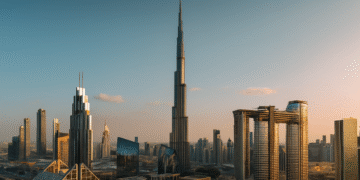



DUBAI, UAE — It started as an editorial experiment: Would ChatGPT, the world’s most advanced AI, invest in Dubai real estate if it were a person?
The AI’s answer was surprisingly thorough — a detailed breakdown of market fundamentals, risks, and strategy. The response piqued the interest of the Invest Dubai Today newsroom. It read less like a chatbot’s musing and more like the output of a seasoned real estate analyst.
This prompted one question worth exploring: What makes Dubai’s property market so compelling that even an algorithm would consider investing in it?
Yields and the Investment Case
Dubai continues to offer rental yields that are higher than those in many mature global markets. Fitch Ratings notes that residential rental yields in Dubai stood at roughly 7.4 percent in 2025, making yields a central pillar of the investment case.
Investors also point to the emirate’s tax environment as an incentive for longer term holdings, since recurring local property taxes are limited compared with some global peers. Taken together, yield and tax structure support a cash-flow oriented approach to property investing in Dubai.
A Market Entering a Cooling Phase
After several years of rapid price gains and record transaction volumes, market advisers and ratings agencies expect a period of moderation. Fitch cautioned that prices could face a moderate correction of up to around 10 to 15 percent in some segments in the second half of 2025 into 2026 as a large delivery pipeline comes on stream.
That moderation, while a near-term headwind, may create entry opportunities for disciplined investors seeking multi-year returns rather than short-term speculation.
Regulatory Protections and Market Structure
Dubai has enacted legal and administrative measures intended to protect buyers and improve transparency in the real estate market. Developers selling off-plan are required to hold buyer funds in project escrow accounts under Law No. 8 of 2007, which limits the use of those funds until construction milestones are met.
Also read: Disneyland Abu Dhabi, RAK Casino Set New Test for Dubai Real Estate
The Real Estate Regulatory Agency and the Oqood registration system provide further layers of oversight for developer licensing and project registration, strengthening investor protections and reducing counterparty risk. These frameworks have been central to shifting Dubai from a highly speculative market toward a more regulated investment environment.
Developer Performance and Market Signals
Major listed developers continue to post robust financial results that reflect sustained demand. Emaar Properties, the emirate’s largest developer, reported a 33 percent rise in first-half 2025 net profit, while reporting a strong increase in property sales and backlog. Those figures underline continued buyer interest in quality projects.
High net worth and luxury activity has also remained notable; earlier Reuters reporting shows that ultra-high-value transactions continued even as new listings tightened, a sign of depth at the top end of the market.
Where a Disciplined Buyer Would Look
A hypothetical, data-driven investor would diversify across established and emerging districts rather than concentrate exclusively in headline neighbourhoods. Emerging communities such as Dubai South, Arjan and Al Jaddaf benefit from improving infrastructure, community amenities and alignment with the Dubai 2040 Urban Master Plan, which seeks to expand accessibility, public spaces and balanced urban growth.
Such locations typically offer lower entry prices and upside tied to infrastructure roll-out and completed amenities. For a multi-year investor this combination of yield and potential appreciation can be attractive when subject to rigorous selection.
Inside ChatGPT’s Hypothetical Investment Plan
Investment Horizon:
The focus would be on a 5- to 7-year holding period, avoiding speculative flipping and aligning with Dubai’s medium-term growth outlook.
Developer Selection:
Only established developers with proven delivery records would make the shortlist. Projects with fully compliant escrow accounts and transparent progress reporting would take priority.
Portfolio Composition:
The portfolio would combine income-yielding residential units with a few branded or mixed-use developments for diversification. The emphasis would remain on the mid to upper-mid market, where yields are stable and volatility lower.
Leverage Approach:
Borrowing would be moderate and backed by conservative stress tests to account for possible rate increases or vacancy risks. The goal would be to ensure financial stability even in a downturn.
Exit Strategy:
Periodic market reviews would guide partial or full exits, depending on price cycles. A liquidity buffer would be maintained to seize opportunities during market corrections.
Key Risks to Monitor
- Oversupply and Price Compression
Fitch forecasts that about 210,000 residential units will be delivered across 2025–2026, nearly double the past three-year supply. This kind of surge could press down prices in segments with weaker demand, especially mid-tier apartments. - Developer Execution & Delay Risk
While escrow laws mitigate fund mismanagement, delays in construction or handovers remain possible — especially in projects by smaller or less capitalized developers. The risk is highest where supply is dense and buyers have limited fallback options. - Rising Interest Rates & Financing Headwinds
As global interest rates climb, borrowing costs in related markets rise too. Even though Dubai is less mortgage-driven compared to some developed markets, higher costs could deter leveraged buyers or slow off-plan sales that depend on post-handover payments. - Policy & Regulatory Shifts
Changes in visa policies, foreign ownership rules, or tax frameworks (e.g. expansions in corporate taxation) could dampen foreign demand or alter the relative attractiveness of real estate as an investment. - Currency / Repatriation Risk
Because the UAE dirham is pegged to the U.S. dollar, investors using weaker currencies may see returns eroded when converting back. Fluctuations in home currencies (e.g. pound, euro, rupee) matter significantly for foreigners.
A Calculated Yes
If ChatGPT were capable of investing, its verdict would be a calculated yes. Dubai’s combination of high rental yields, world-class infrastructure, transparent regulation and visionary urban planning makes it one of the most attractive property markets globally.
However, the AI’s approach would be strategic, not speculative — grounded in due diligence, diversification and long-term positioning.
Dubai’s evolution from a volatile property playground into a disciplined, data-driven real estate ecosystem marks one of the region’s most remarkable economic transformations. For investors — human or artificial — that mix of growth, governance and opportunity is difficult to overlook.
Discover more from Invest Dubai Today - Dubai Realty Insights
Subscribe to get the latest posts sent to your email.