


























UAE — The property market conversation in the UAE has been dominated since April by sellers dropping prices. Nearly 2,800 listings have had AED 1.7 billion cut from their asking prices since the Iran conflict began, according to real estate intelligence platform LuxuryPriceDrops.com, which monitors close to 27,000 live listings.
However, the UAE’s largest developers spent the same period committing billions to assets they intend to hold, not sell. What is taking shape is a deliberate repositioning toward recurring income, and the volume of announcements from a single week makes it difficult to read as coincidence.
Emaar Made AED 8bn Without Selling a Single Unit
Emaar Properties reported AED 8 billion in recurring portfolio EBITDA in 2025, drawn from its hospitality, retail and leasing operations. Aldar Properties has put AED 4.9 billion into develop-to-hold assets. Its develop-to-hold pipeline now sits at AED 20.1 billion.
Aziz Al Sammarai, Assistant Vice-President and Analyst at Moody’s Ratings Corporate Finance Group, told a news outlet this is not a war reaction dressed up as strategy: “While the conflict adds urgency, the diversification into recurring income is better understood as a long-term strategic evolution rather than a reactive pivot. That said, we would expect the current environment to further reinforce this direction.”
On the credit implications of holding these assets, Al Sammarai was direct: “We view this portfolio as a key credit strength, providing a meaningful financial buffer during periods of volatility in the property development cycle.”
The logic runs through the entire institutional stack, not just the listed developers. Family offices including Al Nabooda, AW Rostamani, Al Tayer and Al Futtaim manage yield-generating portfolios across the UAE outside the public developer market. David Abood, Co-CEO of Cushman and Wakefield Core, which advised on Aldar’s AED 1.1 billion acquisition of a Dubai project from SRG Properties last week, put it plainly: “Global capital has not pulled back, with investors confident tensions will ease and still keen to back the UAE’s growth story.”
Three Groundbreakings, Five Days
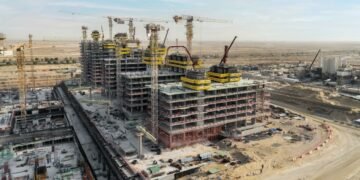
Dubai Holding Asset Management broke ground on Lantana Hills in Dubai Science Park, Al Barsha South. The main construction contract, AED 680 million, went to Group AMANA. The development will deliver 390 townhouses in the second half of 2027, built using DuBox modular construction that cuts waste by 30 percent and improves site safety by 70 percent. It has LEED Silver Precertification.
In Abu Dhabi, BILDCO and Wujod Real Estate announced a joint development spanning approximately 10 million square metres. Phase 1 carries an investment of AED 2 billion and targets ecological estate living and wellness demand from high-net-worth buyers who want something other than urban density.
In Ras Al Khaimah, Central Square passed a structural construction milestone on its 2.27 million square foot Grade A office complex, with a Q4 2027 opening targeted. RAK has been absorbing business and residency demand from people who want UAE proximity without Dubai pricing. The office supply arriving there is not accidental.
Separately, Arada’s recent acquisition of a controlling stake in Reem Hospital, an Abu Dhabi healthcare provider, extends the same logic beyond real estate. Ahmed Alkhoshaibi, Group CEO of Arada, described the rationale in direct terms: “Part of our long-term plan to diversify our revenue streams away from residential development, which tends to be cyclical in nature.”
The $1bn PropTech Bet and What It is Actually For
Dubai Future District Fund confirmed a commitment to Camber Creek, a US-based PropTech venture capital firm with approximately $1 billion in assets under management across 47-plus companies. The portfolio includes Bilt Rewards, VTS, Flex and Measurabl.
DFDF Managing Director Nader Albastaki framed the investment around capital discipline rather than geography: “Their disciplined, high-conviction approach, running concentrated portfolios and following on with their best companies, is a model that consistently generates value and delivers real distributions back to investors. This aligns directly with our mandate to back sector-focused funds that align with Dubai’s D33 Agenda.”
The more specific reason this investment matters is operational. UAE real estate recurring income at scale requires technology to run efficiently. Asset management platforms, tenant experience software and sustainability measurement tools reduce the cost of managing large rental portfolios. Camber Creek’s portfolio is infrastructure for the institutional landlord model. Without it, develop-to-hold strategies carry higher operating margins than they need to.
78% Pre-leased Before Anyone Announced It
Dubai Maritime City inaugurated its Maritime Business Centre 2, an AED 160 million commercial tower, last week. It was delivered in 20 months. Seventy-eight percent of the space was leased before the opening, before any public announcement of the building’s completion.
Ahmed Al Hammadi, COO of Dubai Maritime City, said: “The strong pre-leasing demand for Maritime Business Centre 2 reflects continued confidence in Dubai Maritime City as a strategic destination for maritime and trade-related businesses. As DP World expands into integrated urban and economic zones, projects like this show how we are creating high-quality spaces around our core infrastructure.”
That figure — 78 percent pre-leased before opening — does not describe investor sentiment. It describes occupier demand for completed Grade A commercial space. The gap between what that tells you and what off-plan transaction volumes tell you is the gap between two different parts of the same market.
Aldar’s Al Ghadeer Gardens community sold out in a single session for over AED 1 billion, with 437 townhouses and villas transacting across the Abu Dhabi-Dubai growth corridor. Of the buyers, 83 percent were new to Aldar’s portfolio. Sixty-four percent were expatriates or overseas investors. India was the top buyer nationality.
The Population Math That Complicates Everything
Citi revised UAE population growth projections to 1 percent for 2026, down from roughly 4 percent in recent years. Recurring income assets depend on occupancy. Occupancy depends on people. A 1 percent growth rate does not collapse the thesis, but it removes the margin for error on assets priced for high occupancy.
Distress listings in the off-plan secondary market are circulating at discounts of 10 to 50 percent on some units with Q4 2026 handover. Adding new supply to a market absorbing that overhang creates timing pressure that institutional developers can manage and individual investors often cannot.
Abood, whose firm is advising on active deals, did not dismiss the conflict risk but was clear that it has not stopped transactions: “Even with prolonged conflict causing some delays, activity continues.”
Aldar’s AED 20.1bn Pipeline Is Now the Market’s Test Case
The develop-to-hold pipeline at AED 20.1 billion is the most visible test of this strategy over the next three years. Occupancy rates on completed assets and rental yield data will determine whether the institutional confidence is warranted at current pricing. If Camber Creek portfolio companies begin UAE market operations in the next 12 to 18 months, watch which ones reduce operating friction for large landlords. That is where the recurring income model either becomes competitive or stays expensive.
What the Aldar Sellout Tells NRI Buyers
The clearest data point from this week for Indian and NRI investors is the Aldar Al Ghadeer sellout: AED 1 billion in a single session, India as the top buyer nationality, 83 percent of buyers who had not transacted with Aldar before. That is a price point working in a specific location, for buyers who decided on fundamentals.
UAE real estate recurring income exposure for individual investors currently takes one of two forms: direct acquisition of completed units at rental yields (gross yields are around 7.1 percent market-wide) or investment in listed developers building recurring EBITDA at scale. Both carry Iran-war uncertainty. Neither rewards short-term positioning.
The developer shift toward yield assets does not de-risk a leveraged off-plan position. It does, however, confirm that underlying demand for space in the UAE is more durable than near-term transaction data suggests. For buyers with genuine occupier intent and the liquidity to hold through the current absorption period, that durability is what the argument rests on. Flippers in distress are a different data point. Do not conflate them.
Discover more from Invest Dubai Today - Dubai Realty Insights
Subscribe to get the latest posts sent to your email.