


















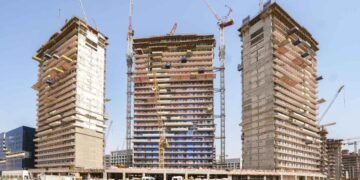


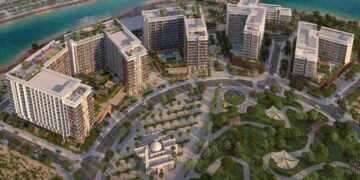









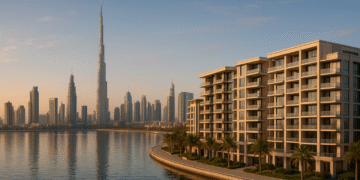




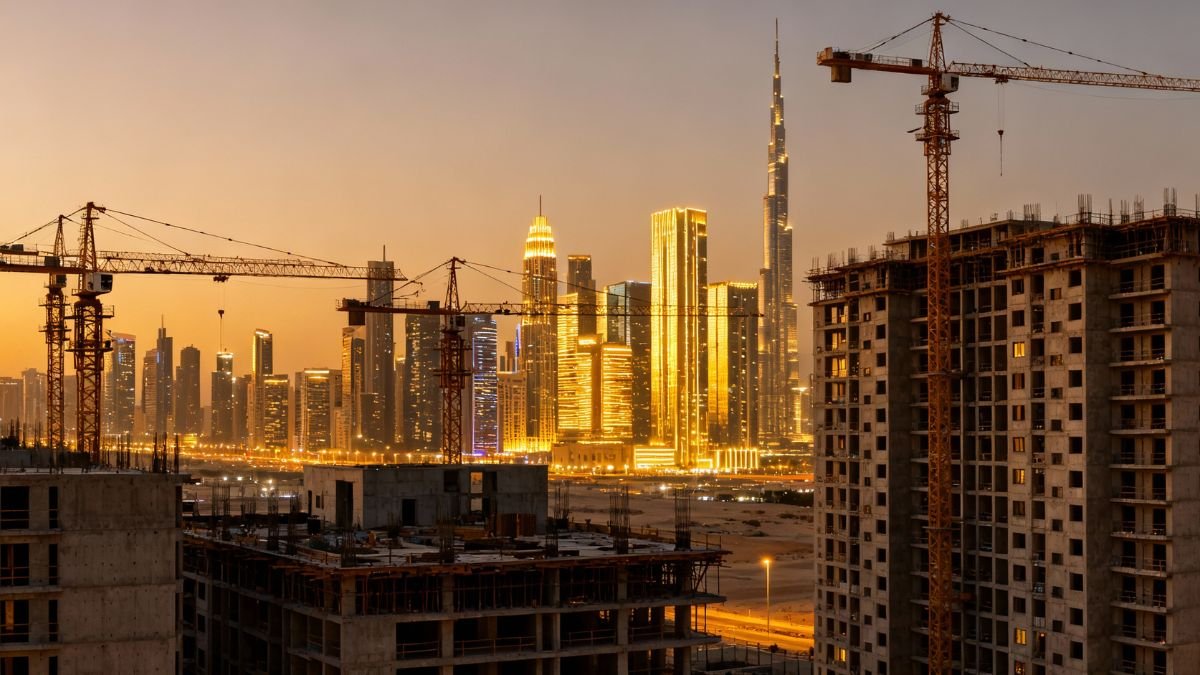
Dubai, UAE — Dubai’s residential market entered 2026 with off-plan transactions continuing to absorb the bulk of capital, even as investors become more selective about location, product type, and execution risk. Week 3 trading data shows that while liquidity remains strong, it is increasingly concentrated in projects and districts where delivery confidence and resale depth are clearer. This shift has direct implications for pricing discipline, rental-led investment strategies, and timing decisions for both investors and end-users.
What Happened
Dubai recorded AED 11.55 billion in total real estate transactions during the third week of 2026, spanning 4,896 deals, according to transaction data compiled from DXB Interact.
Off-plan assets accounted for AED 7.64 billion, representing 66.2% of total traded value, while ready properties contributed AED 3.91 billion, or 33.8%.
Apartments remained the dominant asset class across both segments. Off-plan apartment transactions reached AED 4.80 billion, while ready apartment trades totalled AED 2.37 billion. Villas followed, with off-plan villa deals at AED 1.71 billion and ready villa transactions at AED 746 million.
Also read: Dubai Off-Plan Property Market 2025: Record Sales, Supply Risks Ahead
Commercial real estate also showed consistent activity, contributing AED 1.11 billion in off-plan trades and AED 599 million in ready assets, reinforcing the broader diversification of capital deployment beyond purely residential units.
Dubai Off-Plan Property Transactions Shape Early-2026 Momentum
The continued dominance of Dubai off-plan property transactions reflects a market still favouring staged payment structures and price anchoring at launch rather than immediate yield capture. However, the distribution of volume by area indicates that activity is no longer evenly spread across the city.
Transaction volumes were highest in Al Yufrah 1, Dubai Investment Park Second, and Jumeirah Village Circle, while value concentration leaned toward Palm Jumeirah, Dubai Hills, and Business Bay—a divergence that highlights the growing segmentation between volume-driven and value-driven districts.
This pattern aligns with late-2025 trends identified by brokers and consultants, where investors increasingly separate entry-price strategies from capital-preservation strategies rather than treating the off-plan market as a single risk bucket.
Selectivity Replaces Broad-Based Momentum
While off-plan continues to lead in absolute value, the data suggests that Dubai off-plan property transactions are now concentrated in corridors with clearer delivery pipelines and established leasing depth.
Lower-ticket districts such as JVC and Dubai Investment Park Second continue to attract high transaction counts, reflecting demand from budget-conscious investors and first-time buyers. Meanwhile, higher-value districts such as Palm Jumeirah and Dubai Hills dominate the ready market, indicating a preference for completed stock where pricing certainty and immediate occupancy are prioritised.
This bifurcation points to a market transitioning from volume-led growth toward quality-led pricing, particularly as the supply pipeline for 2026–2027 becomes more visible.
Yield Logic Versus Timing Risk
For investors, the Week 3 data reinforces that Dubai off-plan property transactions remain primarily a timing and pricing play rather than a near-term yield strategy.
Also read: Real Estate Crash UAE? Analysts See Correction, Not Collapse
Off-plan apartments continue to outperform villas in value terms, reflecting lower entry thresholds and broader tenant demand post-handover. Ready apartments, by contrast, attract capital focused on rental income stability rather than price appreciation.
For Indian and NRI investors, currency dynamics remain relevant. AED-denominated assets continue to offer relative stability against INR volatility, but the growing supply pipeline means that exit timing and service charge exposure will matter more than headline launch pricing.
Supply Visibility Is Rising
A key constraint embedded in the current data is the growing volume of upcoming supply, particularly in mid-market apartment corridors. While off-plan absorption remains strong, the concentration of trades in a limited number of districts raises the risk of future pricing pressure if delivery schedules converge.
Execution risk also remains uneven. Not all off-plan projects attracting early capital will deliver on time or maintain resale liquidity, especially as buyer scrutiny increases and financing conditions tighten globally.
What To Watch Next
Over the coming weeks, market observers will track whether Dubai off-plan property transactions continue to command more than two-thirds of weekly traded value or whether ready assets begin to regain share as handovers accelerate.
Attention will also remain on district-level performance, particularly whether volume-heavy zones can sustain pricing once deliveries commence, and whether premium ready markets maintain liquidity amid a growing choice set across the city.
What This Means for Buyers
For investors, the data confirms that Dubai’s market is no longer driven by indiscriminate off-plan participation. Capital is flowing toward projects with clearer execution visibility and exit logic, rather than purely speculative positioning.
For end-users, the steady contribution of ready transactions highlights growing confidence in completed communities, especially for buyers prioritising stability and immediate occupancy.
For Indian and NRI buyers, the current phase rewards discipline. Entry timing, developer track record, and service cost awareness are becoming as important as price per square foot, marking a more mature phase in Dubai’s residential cycle.
Discover more from Invest Dubai Today - Dubai Realty Insights
Subscribe to get the latest posts sent to your email.