



















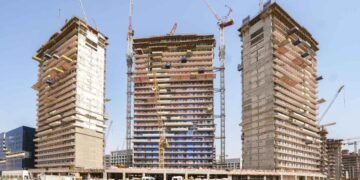

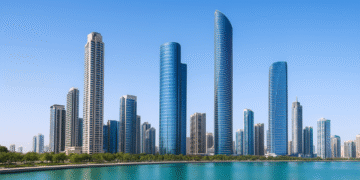










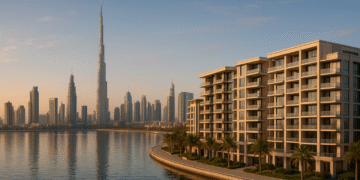





Dubai, UAE – Dubai’s secondary market briefly overtook new launches in Week 7, but the shift was driven by a handful of ultra-large transactions rather than a structural rotation in buyer preference, according to market data compiled from DXB Interact.
Total transactions reached AED 14.11 billion across 5,481 deals, up from AED 11.79 billion and 4,699 transactions a week earlier. That marks a 19.7% increase in value and a 16.6% rise in volume, signalling a higher-activity trading window rather than a directional market reset.
What The Dubai Off-Plan Vs Ready Market Split
The Dubai off-plan vs ready market split Week 7 shows near parity in capital allocation. Ready properties accounted for AED 7.19 billion, or 50.9% of weekly value, while off-plan transactions totalled AED 6.92 billion, representing 49.1%.
At face value, that suggests a temporary tilt toward completed inventory. However, three large partition transactions in Palm Jumeirah — including two in Fairmont Hotel & Resort — accounted for AED 3.27 billion in ready-market activity.
Also read: Serenz by Danube Launch Adds to JVC Off-Plan Apartment Supply
Excluding those outliers, ready volumes would fall to approximately AED 3.91 billion, and the weekly split would reverse sharply toward off-plan dominance. In that adjusted scenario, off-plan would represent roughly 63.9% of total traded value.
The data indicates that the underlying demand engine remains anchored in the primary market.
Off-Plan Capital Remains Apartment-Led
Within off-plan, apartments dominated with AED 4.95 billion in value, accounting for 71.5% of the segment. Villas contributed AED 1.34 billion (19.4%), while commercial assets and hotel apartments formed smaller shares.
Geographically, the top 10 off-plan areas generated AED 3.85 billion, or 55.7% of total off-plan activity. Al Yelayiss 1 led with AED 985.8 million, followed by Al Wasl and Dubai Islands.
This concentration suggests capital continues to favour large-scale master communities and infrastructure-linked growth corridors — a pattern consistent with recent commentary from CBRE and Knight Frank on Dubai’s supply pipeline maturity.
The off-plan bias toward apartments reflects pricing accessibility and payment-plan leverage, particularly for mid-market and upper-mid segments.
Ready Market Strength Concentrated in Prime Nodes
On the ready side, apartments also led with AED 2.78 billion in value. Business Bay topped ready-area activity at AED 559.4 million, followed by Burj Khalifa and JVC.
Excluding the Palm Jumeirah transactions, ready-market activity appears more evenly distributed and aligned with established, rental-producing communities.
This indicates that secondary-market demand remains yield-driven rather than speculative. Investors are targeting cash-flowing inventory in central districts where rental absorption remains firm, according to Bayut and ValuStrat rental trackers.
Structural Trend Still Off-Plan Heavy
The Dubai off-plan vs ready market split Week 7 must be interpreted within Dubai’s broader cycle. Over the past two years, off-plan transactions have consistently accounted for a majority share of value, driven by phased supply releases and developer-backed financing structures.
Also read: Sobha–ADIB Tie-Up Lowers Early-Stage Friction in Dubai Off-Plan Financing
Analysts note that Dubai’s growth model currently relies on controlled new supply launches rather than aggressive secondary-market churn. Developers are calibrating launch volumes against absorption visibility, reducing the risk of inventory overhang seen in previous cycles.
The Week 7 headline ready-market outperformance therefore appears episodic rather than systemic.
Risks and Constraints
The principal constraint remains transaction concentration risk. When weekly performance is heavily influenced by a small number of ultra-large deals, headline figures can distort underlying demand signals.
Additionally, apartment-heavy off-plan pipelines may create pricing pressure in specific micro-markets if handovers cluster within similar timeframes.
Currency movements also remain relevant for Indian and NRI investors. A stronger dirham relative to the rupee can alter entry economics, particularly in mid-ticket segments.
What To Watch Next
Market data indicates that sustained ready-market dominance would require consistent high-value resale liquidity across prime and established communities — not isolated bulk or partition transactions.
Equally important will be off-plan launch velocity. If new project announcements moderate while secondary inventory expands, the split could stabilise closer to equilibrium.
For now, capital behaviour suggests developers retain pricing power, while ready-market demand remains opportunistic and yield-aligned.
Investor Implications
For investors and end-users, the Dubai off-plan vs ready market split Week 7 reinforces a familiar pattern: structural demand continues to favour new launches, but liquidity in prime ready assets can temporarily rebalance value flows.
Also read: Dubai Off-Plan Handover Risk in Focus as Takmeel Breaks Ground
Indian and NRI buyers, in particular, are navigating a dual logic — leveraging developer payment plans in off-plan corridors while selectively acquiring completed apartments in established districts for rental stability.
The broader signal is not rotation, but resilience. Dubai’s market depth is now sufficient to absorb episodic mega-deals without altering its core demand architecture.
Discover more from Invest Dubai Today - Dubai Realty Insights
Subscribe to get the latest posts sent to your email.