































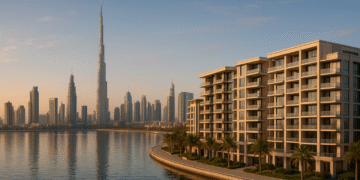





Dubai, UAE — Dubai’s residential market is moving into a delivery-heavy phase, where execution credibility is becoming as important as launch velocity. As more projects approach handover from 2026 onward, buyer attention is shifting toward developers with visible construction progress and defined timelines. Against this backdrop, Mashriq Elite’s transition from launches to deliveries offers a window into how mid-sized developers are positioning for the next stage of the cycle.
Market data shows that while off-plan transactions continue to dominate volumes, pricing power in mid-market corridors increasingly depends on absorption capacity and delivery discipline rather than incentives alone. The Dubai mid-market residential supply pipeline is therefore entering a period where timing, location, and execution risk are central to investment decisions.
What Happened
Dubai-based Mashriq Elite Real Estate Developments said it plans to deliver more than 1,200 residential units across Dubai over the next two years, with 380 apartments targeted for handover in the fourth quarter of 2026 across projects in Arjan and Discovery Gardens.
Also read: Off-Plan vs Ready Properties in Dubai: What Works Best for Indian Buyers?
According to the developer, its cumulative portfolio stands at AED 1.5 billion, covering 1,525 residential units across eight projects. One project has already been handed over, while five are under development and two are scheduled for launch in early 2026.
The developer completed its first residential project, Floarea Residence in Arjan, delivering 206 units in 2025. Projects expected to reach completion in 2026 include Floarea Grande in Arjan with 222 units and Floarea Vista in Discovery Gardens with 158 units, the company said.
Where This Fits in Dubai’s Market
The locations in Mashriq Elite’s pipeline—Arjan, Discovery Gardens, Jumeirah Village Circle, Dubai Land Residential Complex, and Dubai Islands—sit firmly within Dubai’s yield-sensitive, mid-market housing belt. These areas have seen sustained demand from both end-users and investors, but they are also among the districts most exposed to future supply concentration.
Market trackers, including DXB Interact, show that transaction depth in these corridors has remained resilient, largely supported by smaller apartment formats and price points below prime Dubai thresholds. However, analysts have also flagged that a significant share of new supply scheduled from late 2026 onward will be absorbed primarily by these same districts, increasing competition at handover.
This places developers operating in the Dubai mid-market residential supply pipeline under closer scrutiny, as buyers increasingly differentiate between projects based on delivery track record rather than brochure-led positioning.
Execution Over Launch Velocity
From an investor perspective, Mashriq Elite’s current phase highlights a shift from capital raising to capital deployment. With multiple projects now in advanced construction, the developer is entering a period where performance will be judged on handover timelines, build quality, and leasing outcomes rather than sales momentum.
Also read: JVC Oversupply Risk: Are 30,000 New Homes About to Flood Dubai’s Market?
Commenting on the transition, CEO Kamran Muhammad said the company’s focus has been on disciplined growth and adherence to delivery schedules, noting that the developer is moving into a “strong delivery cycle” over the next two years. He added that the company’s footprint across active residential districts will exceed 2 million square feet of built-up area as projects come online.
For investors assessing exposure to the Dubai mid-market residential supply pipeline, this phase matters because returns in these segments are closely tied to rental depth and resale liquidity at completion. Delays or congestion at handover can materially affect pricing outcomes, particularly where competing inventory enters the market simultaneously.
Demand Signals and Buyer Mix
Mashriq Elite said it has seen demand from a mix of global, regional, and local buyers across its projects, including both end-users and investors. This mirrors broader market patterns observed in mid-market districts, where smaller unit sizes and relative affordability continue to attract a wide buyer base.
Brokerage data from Bayut and CBRE indicates that areas such as JVC, Arjan, and Discovery Gardens remain among Dubai’s most actively traded apartment zones, driven by rental demand and comparatively accessible entry prices. However, these same areas are also seeing some of the highest volumes of new project launches, reinforcing the importance of delivery sequencing.
Risk and Constraints to Watch
Despite the visible pipeline, execution risk remains a central consideration. Dubai’s residential market has historically seen delivery timelines shift as projects move from excavation to finishing stages, particularly during periods of elevated construction activity.
Also read: Dubai Off-Plan Property Market 2025: Record Sales, Supply Risks Ahead
Additionally, as supply builds across mid-market corridors, rental growth may moderate if absorption does not keep pace with handovers. Investors entering projects scheduled for completion between 2026 and 2028 will need to monitor leasing depth and service charge levels, especially in districts where multiple developments are set to complete within short windows.
For Indian and NRI buyers, currency stability continues to support dirham-denominated investments, but exit timing and resale liquidity will increasingly depend on project differentiation and delivery credibility rather than headline pricing alone.
What to Watch Next
Key milestones for Mashriq Elite will include progress updates on projects scheduled for Q4 2026 handover and the launch of new developments planned for Meydan and Dubai Production City in early 2026. Observers will also track how completed projects perform in secondary market transactions once handovers begin.
More broadly, the developer’s trajectory will serve as a reference point for how mid-sized players navigate the next phase of the Dubai mid-market residential supply pipeline—where delivery discipline, rather than launch volume, is likely to shape long-term outcomes.
Mashriq Elite’s move into a delivery-focused phase underscores a wider shift underway in Dubai’s residential market. For investors, the emphasis is moving toward execution certainty and post-handover performance in mid-market locations facing rising competition. For end-users, timely delivery and liveability will matter more than speculative price appreciation.
For Indian and NRI buyers in particular, projects entering handover between 2026 and 2028 will test assumptions around rental stability and resale liquidity. As Dubai’s housing cycle matures, developments that convert construction progress into occupier demand are likely to define the next stage of market pricing.
Discover more from Invest Dubai Today - Dubai Realty Insights
Subscribe to get the latest posts sent to your email.