


































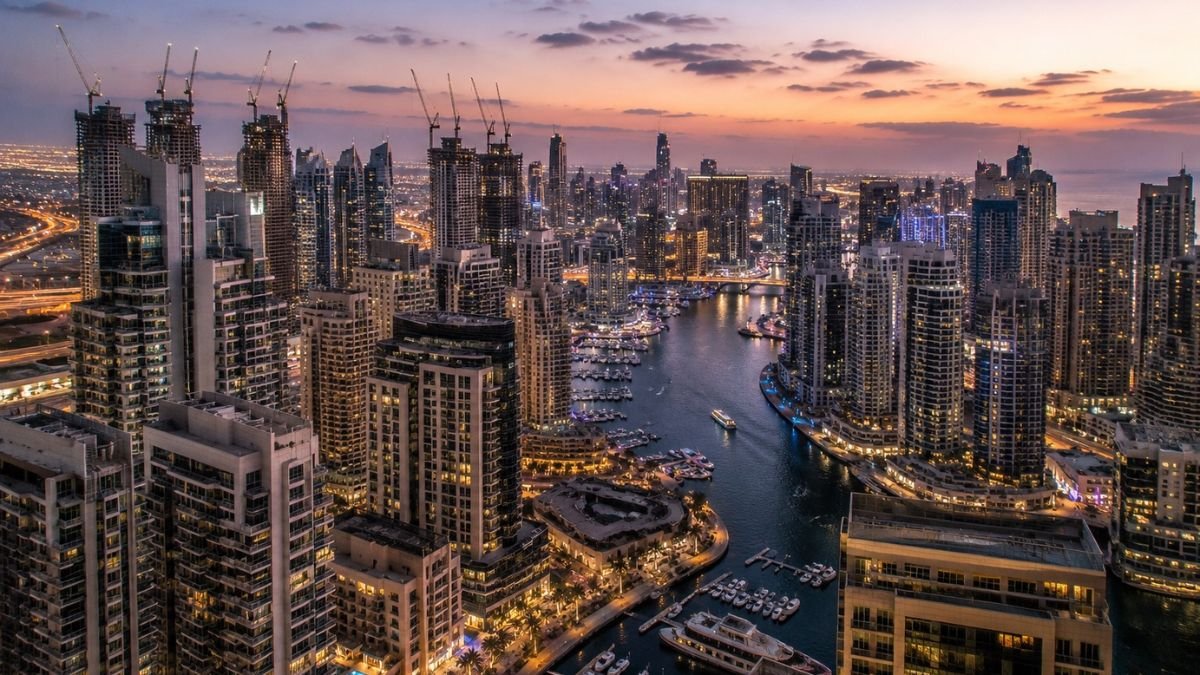
Dubai, UAE — In Dubai Marina, off-plan apartment prices rose 113 percent year on year in April. Completed homes in the same area fell 46 percent over the same period. The numbers describe two entirely different markets operating in the same postcode.
DXB Interact data drawn from Dubai Land Department records shows this is not a Marina anomaly. Across most of the city’s major residential areas, off-plan and ready-home prices are moving in opposite directions, and the direction tells you whether a buyer is parking capital or actually planning to move in.
Off-plan climbs in markets where resale is being cut
Business Bay followed the same pattern: off-plan up 80 percent year on year, ready homes down 6 percent. Palm Jumeirah posted a 12 percent gain in off-plan values while resale prices slipped 2.5 percent.
When buyers treat new units as financial instruments, demand concentrates in off-plan launches where developer payment plans reduce the upfront capital required. The completed buildings next door then face a different kind of buyer, one who is more selective, more price-sensitive, and watching the supply calendar.
Louis Harding, chief executive of Betterhomes, traces the origin of this split to the pandemic. “The UAE saw Covid and reacted in a very proactive way,” he said at a company webinar last month. “It attracted a large proportion of the world’s high net worth individuals who saw it as a cool place to live while [the pandemic] blew over. That created a disproportionate amount of demand in Palm Jumeirah, parts of Downtown and Dubai Hills.” Before that, he noted, “the market was pretty subdued and prices were pretty soft.”
Dubai South shows where this dynamic leads at its most extreme. Ready-home prices there fell 53 percent year on year in April, the steepest drop of any area in the data. Off-plan prices rose 6.4 percent in the same period. The gap widened just as Majid Al Futtaim and Dubai South announced an AED 62 billion development spanning 22 million square feet near Al Maktoum International Airport, a project that will add substantial supply to a sub-market where completed homes are already selling at steep discounts.
Where buyers are actually planning to live
Jumeirah Village Circle and the Greens each recorded gains in ready-home prices, up 10 percent and 18 percent respectively, while off-plan prices were flat or negative. That pattern points to genuine residential demand from people relocating to Dubai and buying to occupy, not to trade. Dubai Creek Harbour showed a similar reversal: off-plan prices fell 20 percent, ready-home values rose 5.7 percent, one of only two areas in the data where resale outperformed new launches.
Downtown was the closest thing to a functioning two-way market. Both segments rose, off-plan by 14 percent and ready by 3 percent, with developer demand and end-user demand pulling in the same direction.
Harding sees this tiering as a lasting structural outcome of the pandemic inflows: “For the first time ever, that created a genuine two or three-tier marketplace. You didn’t see massive disparity in prices over a relatively small geographical area; you do now.” The April figures suggest that gap is widening.
120,000 completions due this year, most to investors who aren’t moving in
Dubai had approximately 120,000 residential units scheduled for handover in 2026. Nearly 366,000 more are projected to complete by 2028. That pipeline carries the most risk in areas where off-plan absorption was driven by investors rather than residents, because those units will eventually land in the same resale pool where prices are already falling.
AGBI reported in May that roughly one in ten homes listed in Dubai had been subject to price reductions, with secondary apartments under the most immediate pressure. The April data is consistent with that reading.
The headline numbers remain strong. Dubai’s total real estate sales exceeded AED 180 billion in the first quarter of 2026, according to Engel and Völkers, with transactions above AED 10 million up 62.6 percent year on year. Ultra-luxury is not the problem. The pressure is sitting in mid-market completed stock in the areas where investor-led off-plan buying was heaviest over the past two years.
The handover clock and what it does to resale assumptions
Off-plan prices rising while ready prices fall creates a specific problem over time. Those off-plan units become resale units. In Marina and Business Bay, they will complete into a pool where prices are already declining. If occupancy does not absorb supply as it lands, the discounts on ready stock deepen further.
Dubai’s population growth and sustained expat inflows provide a real demand floor. A broad correction is unlikely. But in Dubai South, parts of Business Bay, and Marina’s secondary market, investors who bought on developer price trajectories need to test their exit assumptions against resale comparables, not launch prices.
The data that will settle the question by August
May and June transaction figures will show whether April’s divergence is seasonal or has become a structural pattern. Downtown is the cleanest test case: if both segments continue rising in parallel, it establishes where stable pricing actually lives in this cycle. In Dubai South, early absorption rates for the Majid Al Futtaim project will be worth watching. A slow sales launch there would suggest the 53 percent drop in ready values reflects something more durable than a difficult month.
For investors, the April data makes a specific argument: area selection now matters more than city-wide exposure. Markets where off-plan and ready prices rose together, Downtown being the clearest current case, offer more predictable exit conditions. Markets where resale is falling while off-plan sentiment stays elevated, particularly Dubai South, carry resale risk that will arrive with the next wave of completions.
For end-users, the same data offers a concrete entry point. Buyers intending to occupy rather than trade are reaching resale prices shaped by investor pressure, not by residential demand. For Indian and NRI buyers the picture is more specific still: the rupee-to-dirham rate has been favourable through the first half of 2026, and falling ready-home prices in mid-market Dubai have widened the real effective entry cost well below what the off-plan headline numbers suggest. Those buying for long-term rental yield or owner-occupation are in a better position than the promotional figures from new launches imply.
Discover more from Invest Dubai Today - Dubai Realty Insights
Subscribe to get the latest posts sent to your email.