

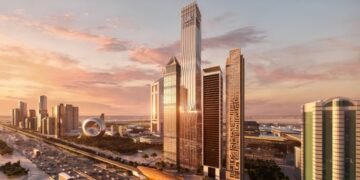







Dubai, UAE — Since the regional conflict began at the end of February, Dubai’s property market has produced one consistent outlier. Transaction volumes across the emirate dipped in March and recovered in April. Dubai South did not dip. It grew.
A market analysis by fäm Properties published June 4, 2026 shows that residential sales transactions at Dubai South rose 36.4% between the onset of conflict and the end of May, even as uncertainty weighed on sentiment across other parts of the city. Off-plan sales alone climbed a cumulative 57.87% over the same period. In May, the district recorded 1,357 transactions worth AED 1.6 billion, a 15.9% volume increase on April — its third consecutive month as Dubai’s best-performing area and its seventh straight month in the emirate’s top five.
That run is worth examining rather than simply reporting.
The buyer here is not the same buyer as everywhere else
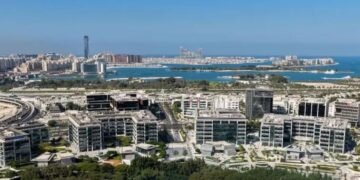
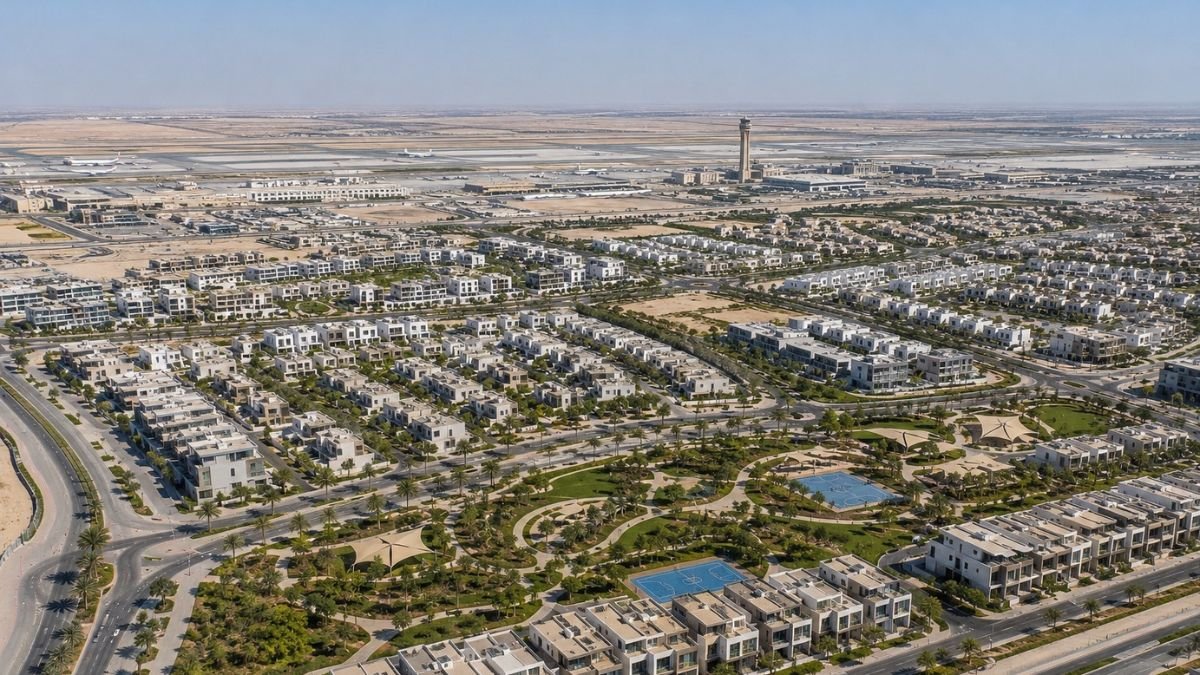
Dubai South is not a marina-front luxury play or a mid-market apartment tower riding the off-plan cycle. It is a 145 square kilometre master-planned city built around Al Maktoum International Airport, the logistics spine of Dubai World Central, and the site of the former Expo 2020. Its residential communities sit adjacent to what is being developed into the world’s largest airport by passenger capacity.
The buyer attracted to this location is responding to a government infrastructure thesis with a 20-year horizon, not a two-year price cycle. That thesis includes the DWC expansion, Expo City’s ongoing activation, a planned metro extension, and the emirate’s stated intent to shift its economic centre of gravity southward. For buyers who believe that thesis holds, a disruption to regional sentiment in March is not a reason to pause. It may be a reason to buy earlier.
“The level of market activity at Dubai South underlines the strength of its fundamentals as a fully integrated, connected urban and business hub propelling growth across the emirate’s broader economy,” said Firas Al Msaddi, CEO of fäm Properties. “Growing transaction volumes reflect genuine end-user and investor confidence in the government’s long-term development vision for this dynamic aviation and logistics ecosystem, underpinned by the expansion of Dubai World Central into the world’s largest airport.”
What the May numbers show across the wider market
Dubai South’s performance sits inside a stronger-than-expected citywide month. According to DXBinteract data cited in the fäm report, Dubai recorded 10,281 sales transactions worth AED 28.9 billion in May 2026. Apartment sales accounted for 8,772 transactions valued at AED 14.6 billion; villa sales reached 1,037 deals worth AED 7.2 billion; plot transactions added AED 4.2 billion across 133 deals. The commercial segment, including offices and retail, logged 335 transactions valued at AED 2.9 billion.
The average property price per sq ft rose 3% year-on-year to AED 1,650. Primary market sales continued to dominate, accounting for 7,595 transactions worth AED 18.5 billion against 2,686 resales valued at AED 10.4 billion.
Dubai South ranked first among all districts in transaction volume. Wadi Al Safa 3 placed second with 983 transactions worth AED 1.7 billion. Jebel Ali First recorded 541 transactions valued at AED 920.9 million, placing fifth — another data point suggesting that the city’s southern corridor is absorbing demand that the established central and coastal communities are not.
The risk that the headline numbers obscure
Of Dubai South’s 1,357 May transactions, 1,233 — roughly 91% — were developer off-plan sales. Secondary market resales accounted for fewer than 125 deals.
That concentration is the most important caveat to the district’s performance narrative. When a top-performing area is driven overwhelmingly by developer launches rather than secondary market activity, the transaction data reflects developer pricing strategy and launch timing as much as genuine market demand. Developers launching in Dubai South control their own volumes by choosing when and at what pace to release inventory.
This does not invalidate the fundamentals argument. But it does mean that the 36% transaction growth figure since February is not purely a demand signal. It is partly a function of how many units fäm Properties and other developers chose to release during a period when buyers in other parts of the city were holding back. The absence of a robust secondary market in Dubai South means investors buying today will find it harder to exit quickly if sentiment shifts before handover.
What to watch before making a decision
The DWC expansion is the single most important variable. If Al Maktoum International ramps capacity on schedule and the planned metro connection to Dubai South is confirmed and funded, the long-term case strengthens considerably. Delays to either would lengthen the horizon over which capital is deployed without visible return.
Handover absorption is the second signal to track. As off-plan units delivered between 2024 and 2025 now reach occupancy, rental yield data from the district will provide clearer evidence of whether end-user demand matches investor entry assumptions. Rental yields in Dubai South have historically ranged between 7% and 9% gross on apartment assets, but that range was established on limited completed stock. A larger delivery cohort arriving in 2026 and 2027 will test whether those figures hold.
Why NRI and Indian investors should look at the entry price carefully
Dubai South’s median apartment transaction price in May sat between AED 550,000 and AED 650,000, based on the best-selling projects in the primary market. At current AED-INR exchange rates, that places the entry threshold between approximately Rs 1.26 crore and Rs 1.5 crore — within reach for a much wider segment of NRI investors than Palm Jumeirah or Downtown Dubai assets.
For Indian buyers weighing Dubai South property investment in 2026, the combination of accessible entry price, tax-free rental income, and long-term airport-infrastructure upside presents a case that is structurally different from the mid-market off-plan plays across JVC or Business Bay where correction risk is more pronounced. The risk here is time horizon, not demand fundamentals. This is a patient-capital market. Investors expecting liquidity within two years should look elsewhere. Those with a five-to-seven year view, and confidence in the DWC thesis, are buying into a district whose performance through a period of regional stress suggests its demand base is more durable than much of what surrounds it.
Discover more from Invest Dubai Today - Dubai Realty Insights
Subscribe to get the latest posts sent to your email.