


























Dubai, UAE — As Dubai’s development pipeline remains active into 2026, attention is increasingly shifting from sales momentum to how projects are executed on the ground. Construction-stage emissions, energy sourcing, and site efficiency are becoming relevant not just for compliance, but for cost control, ESG reporting, and long-term asset positioning.
Against this backdrop, Dubai clean energy construction sites are moving from pilot concepts to live deployment. Sobha Realty’s decision to eliminate diesel generators at Sobha Elwood reflects a broader recalibration in how large residential projects are being built, not just how they are marketed.
What was Announced
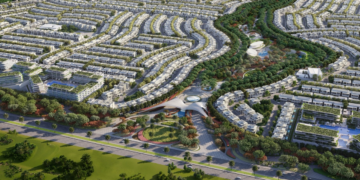
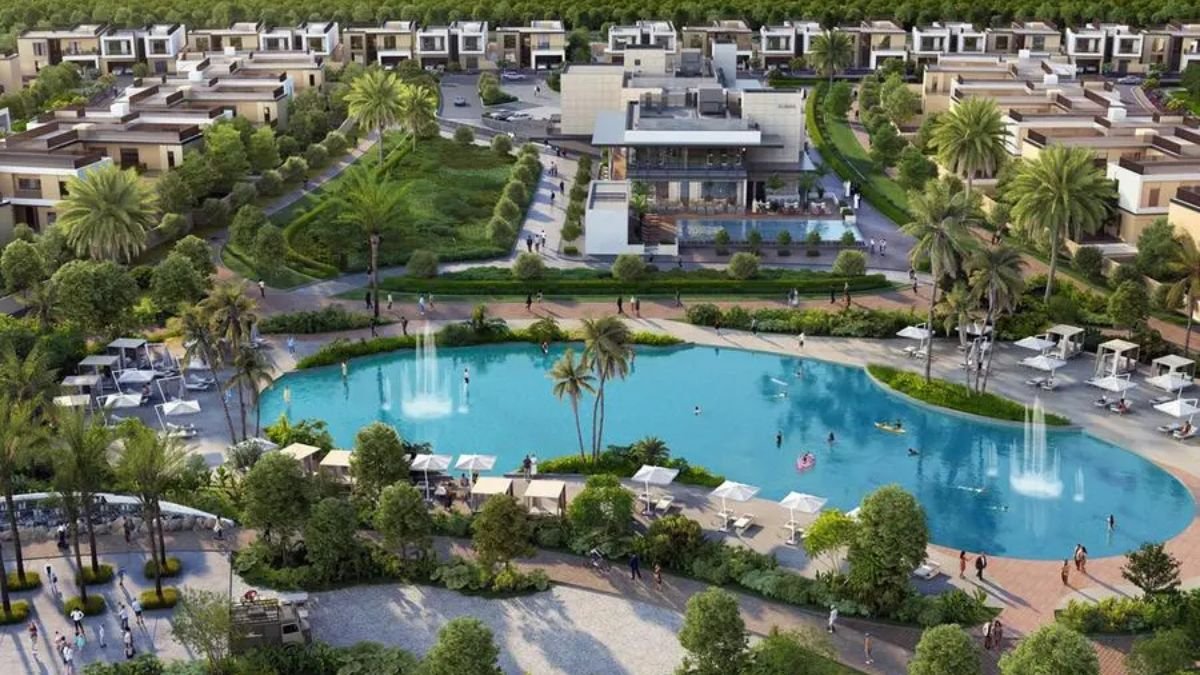
Sobha Realty has entered into a two-year agreement with decarbonisation-as-a-service provider Positive Zero to deploy mobile battery energy storage systems at Sobha Elwood, its luxury villa community under development in Dubai.
Also read: Sobha–ADIB Tie-Up Lowers Early-Stage Friction in Dubai Off-Plan Financing
Under the arrangement, Positive Zero will install the region’s first mobile battery energy storage system (mBESS) at the site, replacing conventional diesel-powered generators typically used during construction. According to the developer, the system delivers electricity without fumes or noise and reduces reliance on fossil fuels during active build phases.
How Construction Power is Being Reconfigured
Unlike fixed on-site power infrastructure, the mobile battery systems operate through swappable battery units charged using renewable solar energy. Batteries are rotated in and out to ensure uninterrupted electricity supply across construction operations.
Sobha said the system is expected to replace more than 30,000 gallons of diesel over the two-year contract period, with an estimated delivery of 219 megawatt hours (MWh) of electricity per year.
At Sobha, the initiative is framed as an execution decision rather than a branding exercise. Ravi Menon, Chairman of Sobha Group, said sustainability considerations are increasingly shaping how projects are delivered.
“At Sobha Realty, sustainability is a fundamental pillar of how we build and how we envision the future of our communities.”
Alignment With Planning and Regulatory Direction
Construction emissions are not yet regulated in the same way as building operations, but they are increasingly visible in ESG disclosures and institutional due diligence. Sobha positioned the initiative as aligned with longer-term planning frameworks rather than near-term compliance.
Also read: Sobha Sanctuary Adds Scale to Dubai Off-Plan Villa Supply
Menon linked the deployment directly to national and emirate-level planning priorities.
“In alignment with the UAE Green Agenda 2030 and the Dubai 2040 Urban Master Plan, this initiative reinforces our commitment to shaping communities that are future-ready and environmentally resilient.”
That alignment matters as large developers seek to future-proof delivery models in anticipation of tighter sustainability benchmarks.
Execution Continuity, Not a One-Off Pilot
Sobha Elwood is the second project where Sobha Realty has deployed Positive Zero’s clean energy systems, following an earlier implementation at Sobha One. Repeat adoption suggests the technology has met reliability thresholds required for active construction environments.
For developers, continuity reduces operational risk, particularly in high-density or villa-scale developments where uninterrupted power supply is critical to delivery timelines.
From the provider’s side, the Sobha contract reflects rising demand for construction-stage decarbonisation. David Auriau, CEO of Positive Zero, said the partnership demonstrates how clean energy solutions can be applied beyond permanent buildings.
“We are delighted to support Sobha Realty in its approach to more sustainable construction and lowering carbon emissions.”
What This Signals for the Wider Market
For Dubai clean energy construction sites, mobile battery systems offer a practical alternative to diesel without requiring permanent infrastructure changes. That flexibility makes them deployable across multiple sites and development phases.
Also read: Sobha Realty Launches Sobha AquaCrest in $20bn Downtown UAQ Masterplan
As sustainability-linked financing and ESG screening become more common, developers able to demonstrate lower construction-phase emissions may gain an advantage with institutional capital and global buyers, particularly in the luxury and premium segments.
Auriau said the Sobha deployment sets a reference point for the sector. “Sobha Realty is demonstrating that clean energy can make a meaningful difference to how cities are built.”
Risk or Constraint
Despite operational benefits, mobile battery systems require careful logistics planning, including charging cycles, transport, and redundancy. At scale, cost efficiency depends on utilisation rates and energy pricing, which may vary across locations and project timelines.
For now, widespread adoption remains concentrated among developers with the scale and balance sheets to absorb early deployment costs.
What to Watch Next
Market observers will track whether Sobha expands mobile battery deployment across additional projects and whether similar systems become standard in construction procurement frameworks.
A key indicator will be whether clean energy use during construction begins to influence lender terms, ESG scoring, or buyer due diligence in Dubai’s residential market.
Sobha’s deployment at Sobha Elwood underscores a quiet but meaningful shift in execution standards. For investors and end-users, the signal is less about immediate sustainability gains and more about operational discipline in a maturing market. For Indian and NRI buyers in particular, such measures reinforce confidence in long-term asset quality, regulatory alignment, and developer credibility—factors that increasingly matter as Dubai transitions from rapid expansion to execution-led growth.
Discover more from Invest Dubai Today - Dubai Realty Insights
Subscribe to get the latest posts sent to your email.