




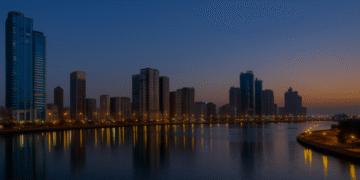
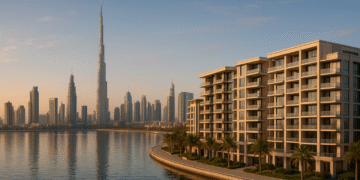


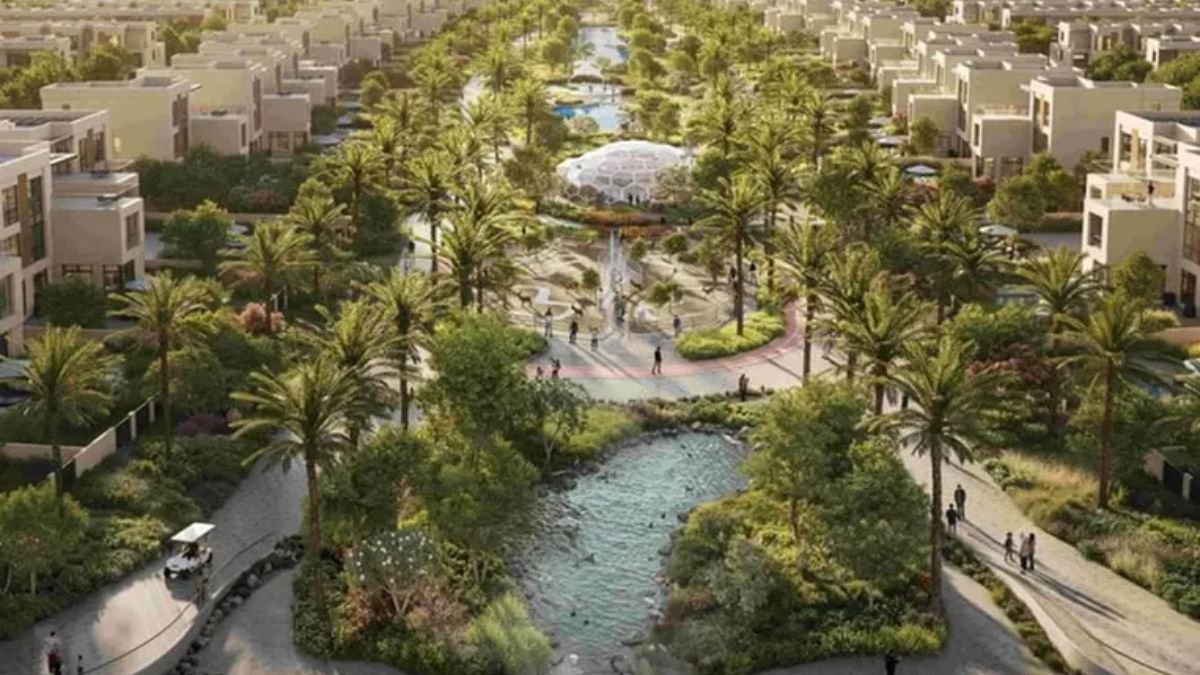
Sharjah, UAE — As Dubai’s residential market absorbs a record off-plan supply pipeline, Sharjah is positioning itself as a lower-volatility alternative for long-term housing demand. The launch of Sharjah Sustainable City II signals growing confidence in end-user-led absorption, where pricing stability, occupancy depth, and holding cost predictability matter more than short-cycle resale activity.
The project’s scale and structure suggest Sharjah is no longer competing on affordability alone, but on delivery certainty and long-term livability—an approach that contrasts sharply with Dubai’s increasingly investor-heavy off-plan cycle.
What Happened
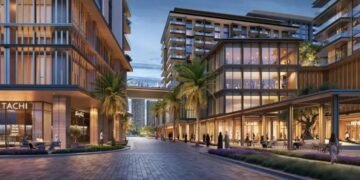
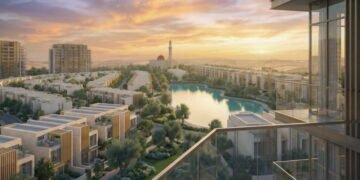
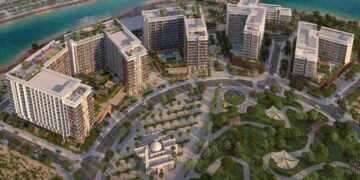
The Sharjah Investment and Development Authority (Shurooq), in partnership with SEE Holding, has announced the launch of Sharjah Sustainable City II, a master-planned residential development in Al Rahmaniya spanning approximately 7.8 million square feet.
Also read: Sharjah Branded Residences Signal Market Maturity Shift
The community will comprise 1,032 homes, including 944 townhouses and 88 five-bedroom villas, offered on a freehold basis for all nationalities, according to the developers. Buyers are also offered zero service charges for the first three years after handover, alongside structured payment plans. The project will be formally showcased at the Sharjah Real Estate Exhibition (ACRES) later this month.
Sharjah’s Counter-Cycle Strategy
The launch comes at a time when Dubai’s housing market is entering a more execution-sensitive phase. Market data from DXB Interact and brokerage reports indicate that while transaction volumes remain strong, buyers are becoming more selective as delivery timelines, service charges, and resale liquidity come under closer scrutiny.
Sharjah’s approach differs in two key ways. First, large-format townhouse and villa supply is being positioned explicitly for long-term occupancy rather than rapid turnover. Second, incentives such as zero service charges act as cost-containment tools rather than sales accelerants, supporting longer holding periods.
Shurooq CEO Ahmed Obaid Al Qaseer said the project builds on the absorption success of the first Sharjah Sustainable City, noting that demand for planned communities with predictable operating costs is rising. His comments align with broader market observations that family-led housing demand is proving more resilient than speculative buying in the current cycle.
Yield Stability Over Velocity
For investors, Sharjah Sustainable City II represents a different risk-return profile from Dubai’s central off-plan zones. Rental yield expectations in Sharjah are typically anchored in occupancy consistency rather than rental spikes, with slower price discovery but lower churn.
Also read: Sharjah Real Estate Transactions Hit Record AED 9.5 Billion
For Indian and NRI buyers in particular, the appeal lies in dirham-linked income, lower entry pricing compared with Dubai villas, and reduced exposure to short-term pricing swings. The zero service charge period improves early-year net yields, although long-term returns will still depend on leasing depth and community maturity.
At the same time, Sharjah remains a less liquid resale market than Dubai. Investors entering at launch should expect longer exit timelines and more limited speculative upside—factors that favour capital preservation over rapid appreciation.
Execution and Delivery Considerations
The scale of the project—over 1,000 homes—places execution discipline at the centre of its investment case. Large townhouse communities require phased handovers, consistent infrastructure delivery, and sustained end-user demand to avoid pricing pressure during completion cycles.
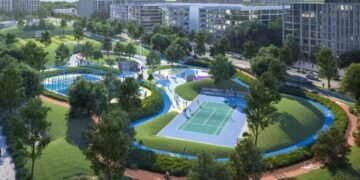
SEE Holding Chairman Faris Saeed highlighted the emphasis on integrated planning and connectivity between residential, green, and social spaces. While such design elements support livability, market observers will closely track construction sequencing and handover pacing as key indicators of delivery risk.
Risk or Constraint
Despite strong positioning, Sharjah Sustainable City II carries absorption risk typical of large master-planned communities. Demand continuity will depend on population growth, employment stability, and Sharjah’s ability to sustain its appeal relative to Dubai’s expanding mid-market villa supply.
Also read: Sharjah Real Estate October 2025 Hits AED 7 Billion Mark
In addition, while service charge relief improves early affordability, longer-term operating costs post-incentive period will be a key variable for both end-users and landlords.
What To Watch Next
Investors and end-users will closely monitor buyer response during ACRES, the project’s payment plan structure, and early indicators of leasing demand once the first phases near completion. Construction milestones and infrastructure delivery timelines will also be critical in assessing whether Sharjah can maintain execution discipline at scale.
Sharjah Sustainable City II underscores a broader shift in the UAE housing market toward quality-anchored, end-user-driven demand. For investors, it offers exposure to lower-volatility residential income with longer holding horizons. For end-users, it provides an alternative to Dubai’s increasingly price-dense villa communities. For Indian and NRI buyers, the project reflects Sharjah’s emergence as a credible long-term residential market rather than a secondary affordability play—though patience on exits remains essential.
Discover more from Invest Dubai Today - Dubai Realty Insights
Subscribe to get the latest posts sent to your email.