































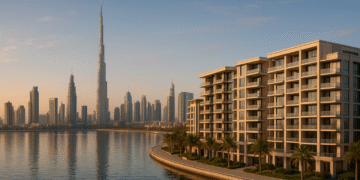





DUBAI, UAE — Indian capital is gaining momentum in Dubai’s high-end real estate market, as wealthy investors from India increasingly target luxury homes across the emirate. This shift in Indian Investor Demand in Dubai’s Luxury Property Market underscores how global wealth flows are converging on Dubai’s premium segment, even as analysts flag signs of moderation ahead.
According to Knight Frank data, sales of homes priced above USD 10 million in Dubai rose 6 % year-on-year in Q1 2024, reaching USD 1.73 billion across 105 transactions. The consultancy noted that international high-net-worth individuals remain the main drivers, with the Palm Jumeirah, Jumeirah Bay Island, and Dubai Hills Estate dominating the leaderboard.
Faisal Durrani, Partner and Head of Research, Middle East and Africa at Knight Frank, said:
“The level of deal activity in Dubai continues to strengthen, particularly at the top end of the market, where the near-constant stream of international high-net-worth individuals vying for the city’s most expensive homes persists.”
Also read: Dubai Luxury Property Market Hits $2 Billion in Q3 2025
Even amid reduced listings, demand remains firm. In the first half of 2024, Dubai recorded 190 ultra-luxury home sales worth USD 3.2 billion, compared to 189 sales during the same period last year. This stability, despite a 65 % drop in available listings, signals long-term conviction among cash buyers. “This is a strong sign of the ‘buy-to-hold’ buyer profile that has taken root in the market,” Durrani added.
Dubai’s largest listed developer, Emaar Properties, reported a 33 % jump in first-half profit in 2025, fueled by a 46 % rise in property sales volume.
Favorable Tax and Residency Policies
The UAE’s tax regime continues to attract Indian investors seeking stability and returns unavailable at home. Dubai offers zero property tax, no capital gains tax, and straightforward freehold ownership for foreigners in designated zones.
Gulf News notes that Indians are the largest group of foreign real estate buyers in the UAE, drawn by “tax-free income, long-term visas, and transparent regulation.”
At the same time, compliance is key. Indian buyers must route transactions through official channels under the Liberalised Remittance Scheme (LRS) and Foreign Exchange Management Act (FEMA), ensuring legal outward remittance of up to USD 250,000 annually. Gulf News warns that using international credit cards or unauthorised channels for Dubai property payments could breach Indian central bank regulations.
Rising Overseas Investment from India
Outbound investment flows from India have expanded sharply. Gulf News reports that affluent Indian investors are expected to deploy USD 20 billion annually abroad, with the UAE remaining a top destination for both real estate and financial assets.
Amit Goenka, Chairman and Managing Director of Nisus Finance, said:
“Affluent Indians are increasingly turning to foreign equities and assets, and we expect these flows to touch $20 billion annually in the coming years. The UAE will remain a natural magnet for this capital, given its real estate depth, business opportunities, and growing financial maturity.”
Supply Pipeline and Cooling Indicators
After three years of record gains, market watchers expect moderation. Fitch Ratings and Reuters both reported in May 2025 that Dubai’s residential prices could see a correction of up to 15 % over 2025–26 as project completions surge.
A January 2024 Reuters report quoted former Dubai finance chief Nasser al-Shaikh expressing caution:
“My worry is the state of the global economy… whatever happens in other places affects us.”
Despite the risks, Dubai’s fundamentals remain robust: strong population growth, a diversified economy under the Dubai D33 Economic Agenda, and consistent inflows of high-net-worth residents.
Regulatory and Currency Considerations
Indian investors face procedural hurdles. Under Indian law, property purchases abroad must comply with RBI norms, and mortgage financing in the UAE typically excludes ancillary costs like brokerage or registration fees.
Exchange-rate fluctuations between the Indian rupee and UAE dirham can affect returns. A stronger rupee at the time of sale can reduce repatriated profits, making currency strategy an important factor in long-term planning.
Outlook and Guidance for Indian Buyers
- Stick to Reputable Developers: Choose established builders with a strong record of delivery and compliance.
- Use Legal Remittance Channels: Follow RBI’s LRS guidelines and avoid informal transfers or non-compliant payment methods.
- Diversify Within the Market: Consider a blend of off-plan and completed assets, and avoid overexposure to a single district.
- Plan for Exit: Build in time horizons of at least 5–7 years, factoring in transaction costs, visa benefits, and resale liquidity.
- Monitor Global Trends: Global interest rate cycles and currency shifts will continue to influence capital appreciation potential.
Despite some supply pressures, Dubai’s top-end housing remains resilient, buoyed by genuine end-user demand and foreign capital flows. The emirate continues to offer a combination of yield, lifestyle, and legal clarity that few competing markets can match.
As wealth mobility grows and India’s affluent class expands, Indian Investor Demand in Dubai’s Luxury Property Market is poised to remain a defining force — shaping both the skyline and the cross-border investment landscape for years to come.
Discover more from Invest Dubai Today - Dubai Realty Insights
Subscribe to get the latest posts sent to your email.